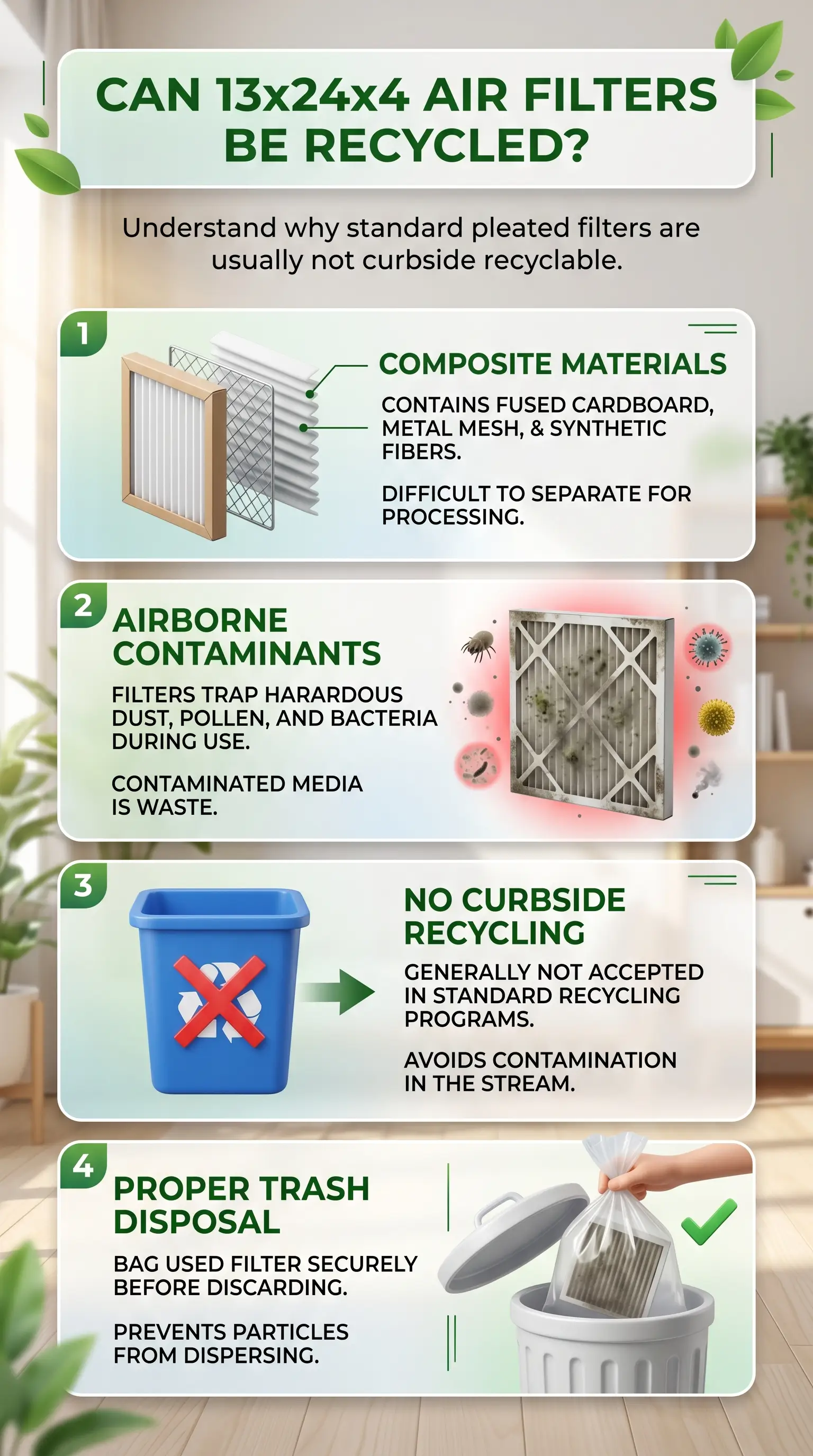
Drop your used 13x24x4 filter in the recycling bin and it'll get pulled right back out, possibly earning you a fine in some municipalities. Most homeowners don't hear that until they've already done it. We've manufactured pleated filters in Alabama, Florida, Pennsylvania, and Utah since 2013, and between our team and the city waste programs we've talked to, we know where your used filter belongs. We also know why pairing a better filter with options like professional UV light installation does more for your indoor air (and the landfill) than recycling ever will.
TL;DR Quick Answers
Most curbside recycling programs won't take a 13x24x4 air filter.
Seal the used filter in a bag and place it in your household trash.
A longer-lasting 4-inch pleated filter reduces waste more than any recycling workaround.
Plan on a change every 60 to 90 days under normal conditions.
American-made pleated filters on auto-delivery beat one-off shelf purchases.
Top Takeaways
Most curbside recycling programs won't accept a 13x24x4 air filter because of its composite materials and the contaminants trapped inside.
Seal a used filter in a plastic bag before you toss it, so allergens, dust, and mold spores stay contained.
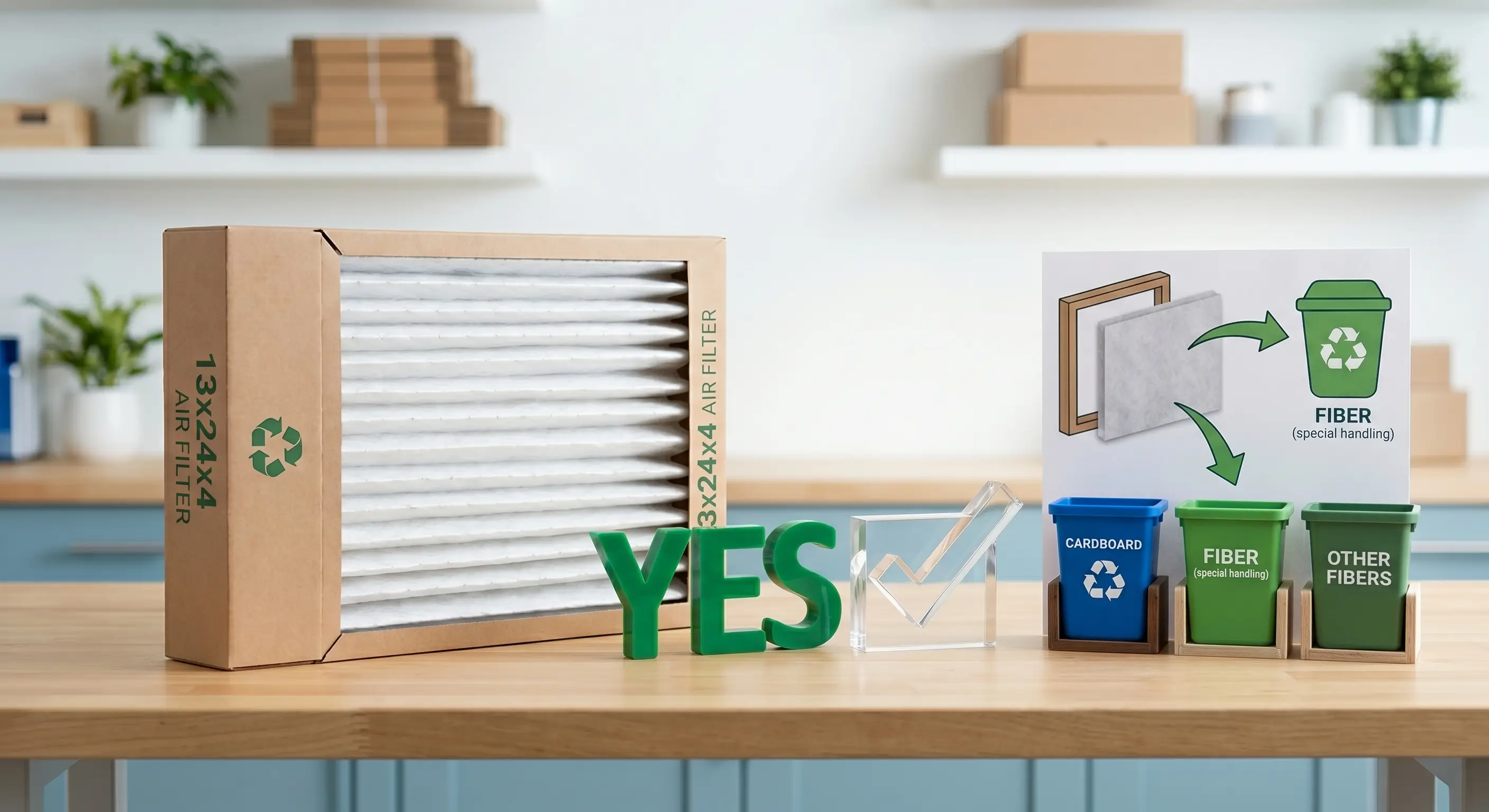
Some specialty programs will take just the cardboard frame if you fully separate it from the filter media, though local rules vary widely.
4-inch pleated filters last longer and produce less waste per year than standard 1-inch pleated filters.
American-made filters travel shorter distances, which cuts transportation emissions along the way.
Regular HVAC upkeep extends filter life, and knowing your HVAC installation costs helps you budget for system upgrades that work alongside smarter filtration.
What's Actually Inside a 13x24x4 Filter (and Why It Can't Be Recycled)
A residential air filter is a hybrid of three materials: a cardboard frame, pleated synthetic media (usually polyester or fiberglass), and in some models a thin wire or metal mesh backing. That construction is what makes it good at catching dust, pet dander, and mold spores. It's also what makes it a poor fit for curbside recycling. Municipal recycling facilities handle single-material streams like cardboard, aluminum, or #1 plastics, and a used filter packed with bagged dust sits well outside that scope. The same construction holds whether you run dust defense replacement panels in a smaller return, thicker quality pleated filters in a hallway unit, or 5-inch pleated filters in a grille-mounted system.
Here's the disposal process our customer team walks homeowners through:
Shut off the HVAC system before you pull the filter.
Seal the used 13x24x4 filter in a plastic bag so trapped dust and spores stay contained.
Put the bagged filter in with your regular household trash.
Don't burn it. Synthetic filter media can release fumes that are genuinely bad for the air you're trying to clean.
Buying fewer filters each year does more for the environment than recycling ever could. A thicker pleated design slows your replacement cadence, and some of our customers pair their 13x24x4 with thicker HVAC filters in secondary returns or add UV air purifiers for another layer of protection on airflow that's already been cleaned once.
Not every home is built for a 13x24x4. Households running different filter sizes or setting up whole-house air filtration can follow the same three habits: pick the deepest media the system will accept, stick to the manufacturer's change schedule, and order ahead so you're not grabbing whatever's on a hardware-store shelf at 9 p.m. on a Sunday. Homeowners ready to upgrade can switch to our premium 13x24x4 air filters, which we manufacture in Alabama, Florida, Pennsylvania, and Utah with deeper media packs that last longer between changes.
"In the tens of thousands of homes we've helped since 2013, customers who switch to a deeper pleated filter consistently report the same outcome: fewer trips to the landfill every year, and a quieter HVAC system that shows up on the next energy bill."
7 Essential Resources
Three Statistics From the EPA and ENERGY STAR
Americans spend roughly 90% of their time indoors, where pollutant concentrations are often 2 to 5 times higher than typical outdoor levels. Source: EPA — Indoor Air Quality
U.S. landfills took in about 146.1 million tons of municipal solid waste in 2018, per EPA figures, which is why extending filter life matters more than any recycling workaround. Source: EPA — National Overview: Facts and Figures on Materials, Wastes and Recycling
Heating and cooling account for close to half the energy used in a typical U.S. home, making a clean, properly sized filter one of the most cost-effective ways to cut energy waste and filter replacements together. Source: ENERGY STAR — Heat & Cool Efficiently
Final Thoughts and Opinion
In our experience, "Can I recycle this filter?" is the second question homeowners should ask. The first, and the higher-impact one, is whether you can simply buy fewer filters a year. Switching from a 1-inch filter to a 4-inch 13x24x4 typically moves replacement from every 30 days to every 60 to 90. That's up to eight fewer filters heading to the landfill from a single household, plus a cleaner-running HVAC system for the family breathing the air it pushes.
For households that want to go further, bulk pleated filters and 12-pack bulk options reduce packaging waste per unit, and allergy-sensitive homes can pair them with HEPA home filters or compatible upgrades in the rooms where air quality matters most. Recycling is an imperfect backstop, and smarter buying with longer-lasting filters will always do more for your home and the landfill.
Frequently Asked Questions
Can I put my used 13x24x4 air filter in curbside recycling?
No. Between the mixed materials and the contaminants packed into a used filter, most curbside programs treat it as household trash or contamination. A few cities will fine you for putting it in the blue bin.
How often should 13x24x4 air filters be replaced?
Most 4-inch pleated filters last 60 to 90 days under normal conditions. Homes with pets, allergies, wildfire smoke exposure, or heavy HVAC use may need changes closer to every 60 days.
Should I upgrade my MERV rating to reduce waste?
Often yes. A MERV 11 filter catches more fine particulates than a standard MERV 8, and because it pulls more out of the air between changes, it keeps downstream components cleaner and indirectly extends filter life. Always check your system's airflow spec before upgrading, since not every HVAC unit can push through higher-MERV media without strain.
Can I wash and reuse a standard 13x24x4 air filter?
No. Standard pleated 13x24x4 filters aren't washable. Water damages the media and wrecks filtration performance. Only filters explicitly labeled "washable" or "reusable" should ever be cleaned and put back in the system.
Does buying in bulk actually reduce waste?
Yes, when it replaces multiple small orders. Households with predictable replacement schedules can use bulk filter orders to consolidate packaging and delivery trips, and both factors lower the footprint of your filter habit over the course of a year.
Breathe Easier Starts Here
Stop guessing about filter size, replacement timing, and waste reduction. Shop our MERV-rated 13x24x4 pleated filters, set up auto-delivery so you're never over-buying, or talk with one of our air quality team members for a recommendation tailored to your home. Better Air For All starts with the filter sitting in your return vent right now.
Shop 13x24x4 Air Filters → Subscribe to Auto-Delivery → Talk to an Air Quality Expert →
Learn more about HVAC Care from one of our HVAC solutions branches…
Filterbuy HVAC Solutions - Miami FL - Air Conditioning Service
1300 S Miami Ave Apt 4806 Miami FL 33130
(305) 306-5027
https://maps.app.goo.gl/Ci1vrL596LhvXKU79